Introduction: Beyond the Event Horizon
In 1958, in a tribute to the mathematician John von Neumann, his colleague Stanislaw Ulam recalled a conversation about "the ever accelerating progress of technology and changes in the mode of human life, which gives the appearance of approaching some essential singularity in the history of the race beyond which human affairs, as we know them, could not continue."
Seven years later, the British statistician I. J. Good described how such a singularity might arrive. He imagined an "ultraintelligent machine," one that could surpass the intellectual work of any human, however clever. Designing machines is intellectual work, so such a machine could design a better machine, and that machine a better one still. Good called the result an "intelligence explosion."
In March 1993, the mathematician Vernor Vinge joined the two ideas in a talk called "The Coming Technological Singularity." Its first two sentences are among the most quoted in the field: "Within thirty years, we will have the technological means to create superhuman intelligence. Shortly after, the human era will be ended."
For decades the idea belonged to science fiction writers. In 2018 it acquired financial backing. OpenAI's charter defines its goal as artificial general intelligence, "highly autonomous systems that outperform humans at most economically valuable work." The release of ChatGPT in November 2022 turned that goal into a consumer product, and the leading labs began to say openly that they expected systems to match or beat people at most cognitive work within years, not decades. Tens of billions of dollars, then hundreds of billions, followed into chips, data centers, and power plants. Whatever one thinks of the forecasts, the thought experiment is now a business financed through the capital markets.
Good closed his paper with the sentence that made it famous: "the first ultraintelligent machine is the last invention that man need ever make." Sixty years later, we are building that machine. If it works as its builders promise, it will make every invention that follows. For an investor, that raises an obvious question: is the last invention also the last investment?
This paper is about that question.
Good's sentence is usually read as a prediction about technology. It is also a claim about economics. If one machine can make every invention that follows, then the value of all future innovation runs through it: every new drug, material, and design, every improvement to every product, every business built on a better idea. Whoever owns that machine would seem to own the future. That is the bet the capital markets are now making. The companies building the last invention are raising hundreds of billions of dollars on the promise that whoever builds it first will capture what it creates. History suggests caution. Every earlier general-purpose technology looked as if it would hand the world to its builders, and none did. William Nordhaus estimated that inventors keep only about 2 percent of the value their inventions create. If that pattern holds even for the last invention, the value of everything it invents will flow mostly to the people who use it, and to the owners of whatever the machine cannot make. This paper asks which outcome is more likely, and what an investor should do about each.
History can test the question. The last invention would be new, but the question of who captures the value of invention is not. The steam engine, the railway, electricity, the automobile, the computer, and the internet were each, in their day, the invention that made the next generation of inventions possible. Each was expected to make its builders rich beyond measure. Each produced booms, crashes, fortunes, and ruins. And each left a pattern in who captured the value it created.
That pattern is the paper's central thread. Its first lesson is uncomfortable for anyone hoping to get rich by backing the right AI lab: the builders of a transformative technology often do not keep most of the value. Railway investors in 1840s Britain built a national network and lost much of their capital doing it. Airlines have carried billions of passengers while earning, over their history, little or nothing for shareholders. Most of the value of each revolution flowed to the people who used the new technology, and to the owners of whatever became scarce once it arrived. If that pattern holds, the last invention will not be the last investment. The machine may change everything, and the people who pay to build it may still keep the least.
The paper proceeds in three parts.
Part 1, The Singularity, explains the idea itself: where it came from, what serious people mean by it, how fast it might arrive, and why it is really a question about the returns to capital and labor.
Part 2, Historical Tech Revolutions, studies the precedents. Carlota Perez shows that revolutions move through a recurring cycle of installation, frenzy, crash, and deployment. William Nordhaus estimates how little of the value of innovation its inventors capture. Clayton Christensen explains why profits do not vanish but migrate to the next bottleneck in the chain. And the record of asset prices, sorted industry by industry, shows what actually happened to investors who lived through each surge, and which layers of a revolution rewarded them.
Part 3, The Unforeseeable Future, applies those lessons to a world that may not resemble any precedent. It asks what happens to wages, interest rates, and asset prices when intelligence becomes cheap; what stays scarce when almost everything else does not; which businesses lose when the work they sell becomes cheap, and why their stocks can look deceptively inexpensive; and how to build a portfolio that survives being wrong about all of it.
No one can tell you what lies past the event horizon. This paper will not pretend to. What it can offer is a way of standing at the edge with your eyes open.
Part 1. The Singularity
The curves are real
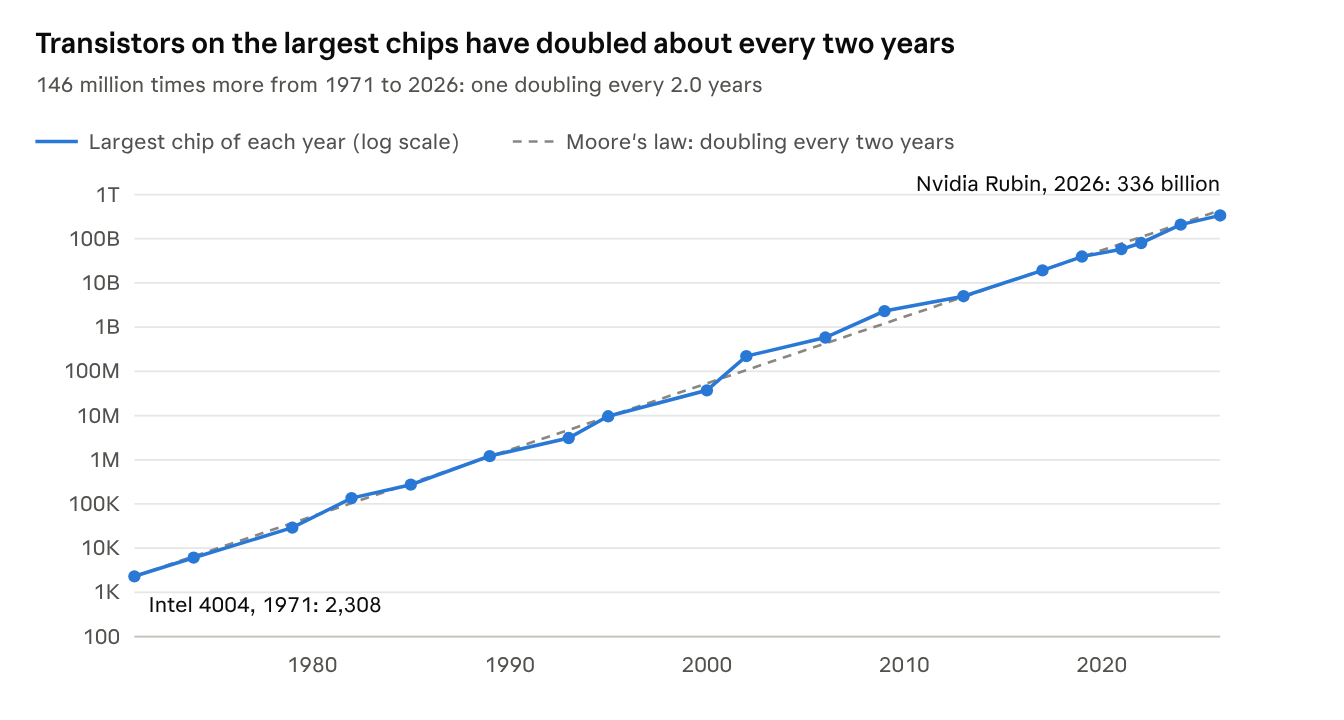
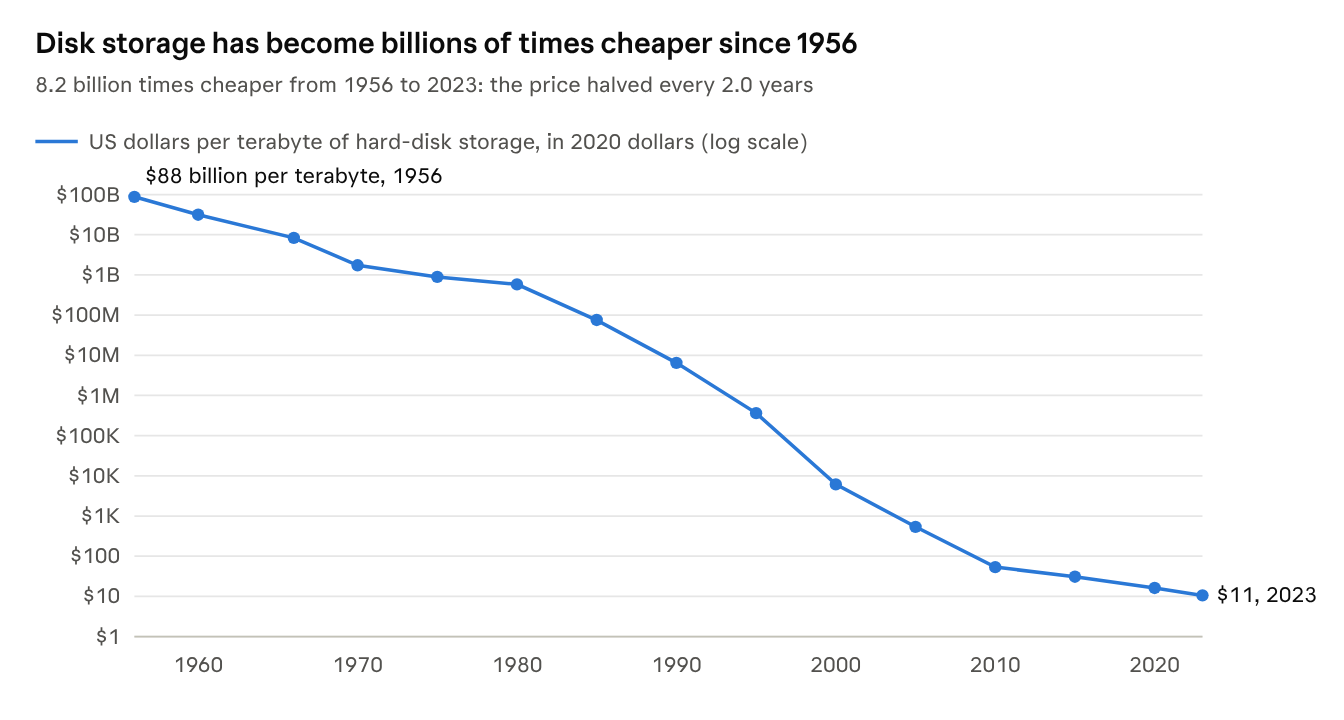
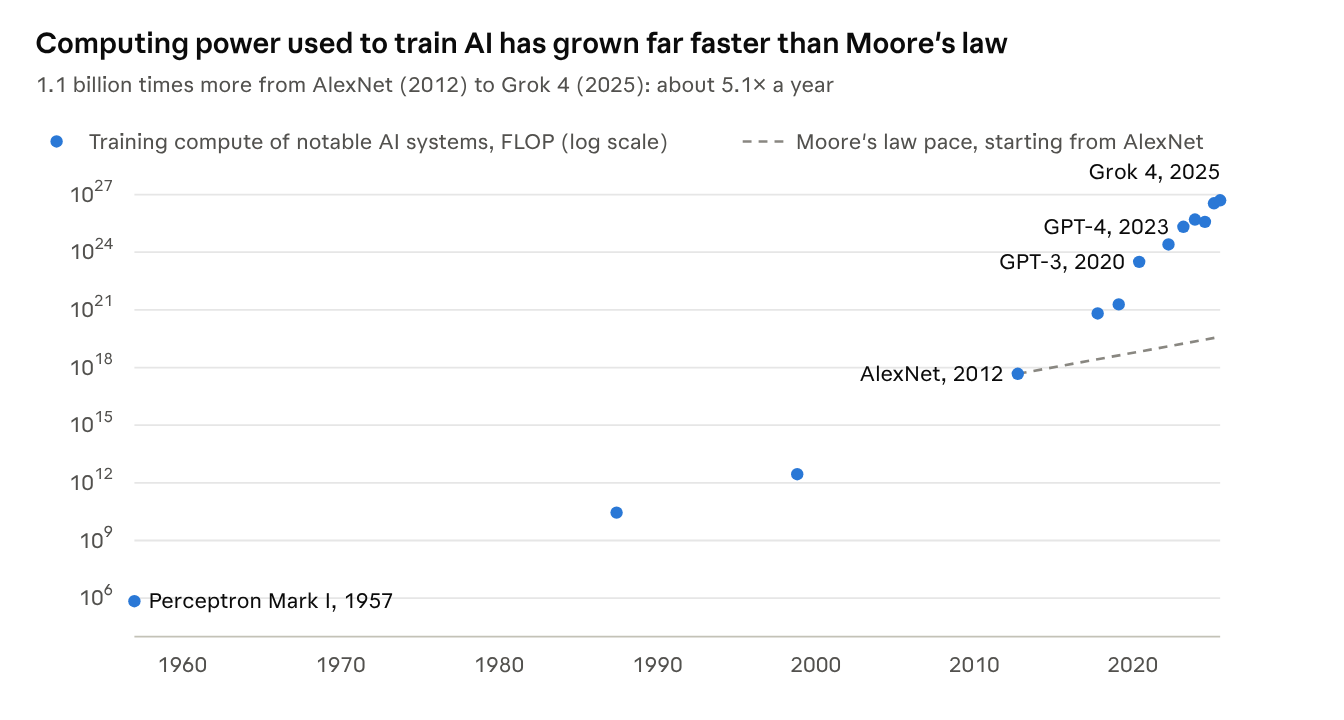
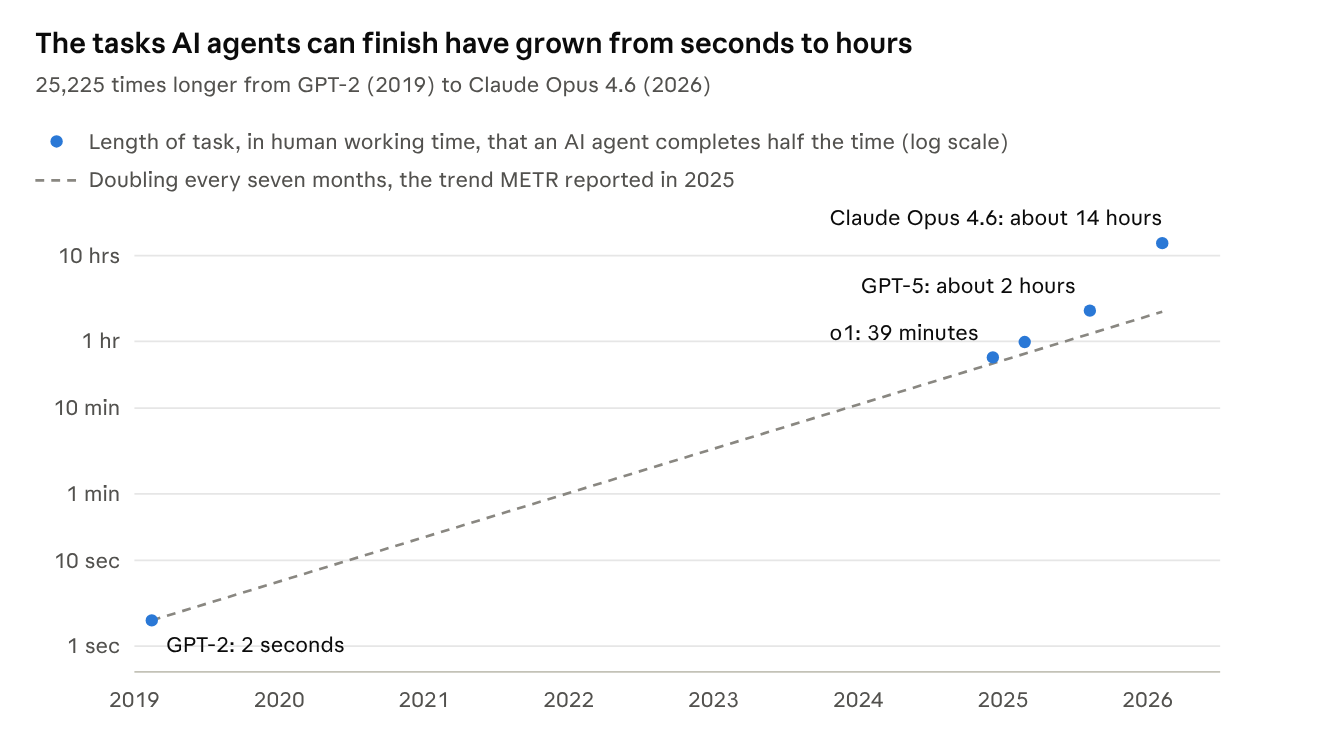
People take the singularity seriously because of a handful of curves. For sixty years, computers have improved at a pace that is hard to picture. The charts below show four of them. Transistors on a chip have doubled about every two years since 1971. Storage has become billions of times cheaper. The computing power used to train AI has grown about 4.5 times a year since 2010, far faster than Moore's law. And the length of task an AI agent can finish on its own has grown from seconds to hours.
The third curve comes with a warning. Most of its growth came from companies spending more, not from chips getting cheaper. A curve driven by cheaper chips is hard to stop. A curve driven by bigger budgets lasts only as long as someone keeps paying. For investors, the question is who pays, and whether they get their money back.
The singularity that matters to investors
The word has three meanings. The intelligence explosion is Good's idea of machines improving machines. The event horizon is Vinge's claim that past a certain point the future cannot be forecast. The economic singularity is the point at which AI can do most of the work people are paid for, and the cost of thinking falls toward the cost of the electricity that runs it.
For an investor, Good's idea and the economic singularity are two halves of the same question. A machine that makes every invention after it would also drive the cost of cognitive work toward zero, and that would reprice wages, profits, interest rates, and every asset whose value depends on them. The event horizon matters mostly as a problem of valuation. It makes the pricing harder without saying who gets paid. William Nordhaus listed what the economy should show as that point approached: faster growth in productivity and wages, capital taking a rising share of income, collapsing prices for capital goods. On data into the 2010s, he found none of it. One of his signals has since moved. Labor's share of US income is at a record low. On its own that proves little. We come back to it at the end.
No one knows how fast
If the curves are real, the next question is how fast, and the experts disagree. One camp expects a fast takeoff: copies of an AI researcher are cheap, research is mostly digital, and each gain makes the next one easier to find. The other expects a slow one, held back by chips, power, experiments, and institutions that take decades to change. Even the slow case would be dramatic. Paul Christiano's test for it is world output doubling in four years, a pace no economy has ever sustained.
We are also bad at judging the pace. People overestimate new technologies in the short run and underestimate them in the long run, an observation credited to Roy Amara and repeated by Bill Gates. Gartner's hype cycle draws it as a curve.
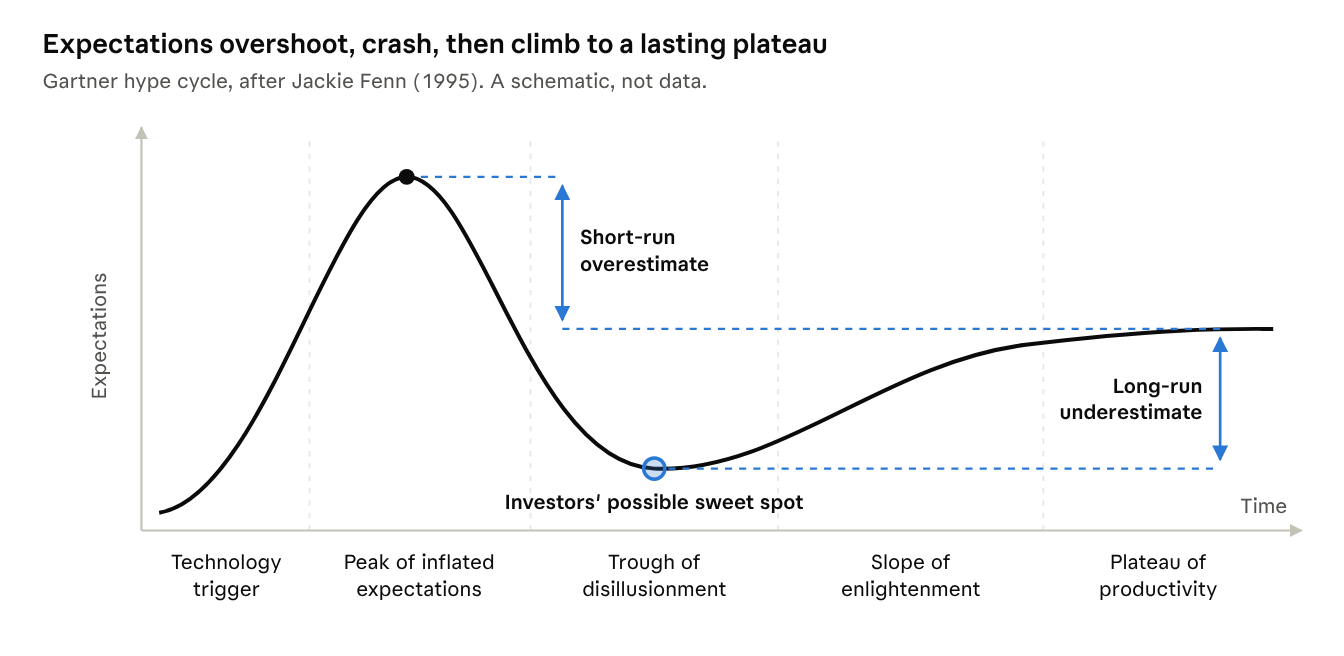
For investors, the gap between the peak and the plateau can be an opportunity or a trap. Buyers in the trough have often done well, and buyers at the peak have often waited decades. But most technologies never trace the full curve, and a technology that improves itself might compress it into months.
The latest evidence shows how hard it is to tell. In November 2026, the evaluation group METR found that AI was helping one leading lab, Anthropic, improve its models at about twice its earlier pace: the first measurement of Good's loop at work. Eight days later, the economists Alex Imas and Luis Garicano read the same evidence differently. Research spending had risen about 6.2 times to buy that doubling, so each dollar bought less progress, not more. On their reading, AI is improving quickly but expensively, and keeping up the pace would require spending to grow about fourfold a year. It is too early to know which reading is right.
Why this is an investing problem
Every asset price is a forecast of future cash flows, discounted back to today. The singularity undermines the cash flows, the discount rate, and the forecast.
Start with the cash flows. If machines do most paid work, income shifts from wages to whoever owns the machines. That sounds like good news for shareholders, but capital earning more is not the same as your capital earning more. Then the discount rate. When people expect to be much richer, they save less and real interest rates rise, which hurts the long-duration growth stocks that look like the obvious bet on AI. Real rates on 30-year inflation-protected Treasuries reached their highest level since 2001 in August 2026. Finally, the forecast. More than half of an ordinary company's value comes from beyond the next ten years, the years the singularity says we cannot see.
So whether the last invention is also the last investment cannot be settled by a forecast. It can be tested against history, by asking the question beneath Good's: when a technology creates enormous value, who keeps it? Part 2 traces the answer.
Part 2. Historical Tech Revolutions
No earlier revolution claimed to be the last invention. But each produced the same fear among investors of missing out on the technology that would remake the world. Railway shares in the 1840s, radio and automobile stocks in the 1920s, and internet stocks in the 1990s all drew buyers who were less afraid of overpaying than of being left behind. Part 2 looks at what happened to them.
Every revolution is paid for by a bubble
The economic historian Carlota Perez has shown that the great technological revolutions since 1771 follow the same rhythm. First comes an installation period, when the new infrastructure is built: canals, railways, power lines, fiber. It is financed by a speculative frenzy because no sober investor would fund it at the prices the builders need. The frenzy ends in a crash. Then comes a deployment period, often a golden age, in which the rest of the economy learns to use what was built and the gains spread.
The rhythm separates two questions that are easy to confuse: whether a technology will change the world, and whether the people paying for it will make money. In Perez's history the answer to the first is usually yes and the answer to the second usually no. The bubble is how the infrastructure gets paid for.
Where AI sits in that rhythm is open. Perez herself sees it as a late leap within the information revolution that began with the microprocessor in 1971. Others see the start of a new surge, with its frenzy and crash still ahead. The singularity raises a third possibility: that a technology able to improve itself will not wait the half century people have always needed to adapt.
The builders rarely keep the value
Warren Buffett made a similar point in November 1999, at the top of the dot-com boom. "The key to investing," he wrote in Fortune, "is not assessing how much an industry is going to affect society." It is "determining the competitive advantage of any given company and, above all, the durability of that advantage."
The record supports him. British investors in the 1840s built a national railway network and lost much of their capital doing it. Electricity became a regulated utility, and its productivity gains took forty years to arrive. Buffett counted at least 2,000 American car makes; three survived, "themselves no lollapaloozas for investors." The telecom companies of the 1990s laid fiber that was at least 95 percent dark in 2002, went bankrupt, and left the cables to the companies that built the modern internet on them.
The few builders that did well had one of two things. Some bought cheaply, after the crash rather than during the frenzy. Others controlled something that stayed scarce after the technology made everything else cheap: a standard, a resource, the customer. Price and position come up again and again in what follows.
Most of the value goes to users
If the builders do not keep the value, who does? The economist William Nordhaus estimated that innovators in the postwar US economy captured about 2.2 percent of the value their innovations created. The other 98 percent went to everyone else, as lower prices and better products. Ideas spread, competitors copy them, and the premium a new product earns is competed away.
His most famous example is light. In 1800, buying a fixed amount of light took more than five hours of work. By 1992 it took less than half a second.
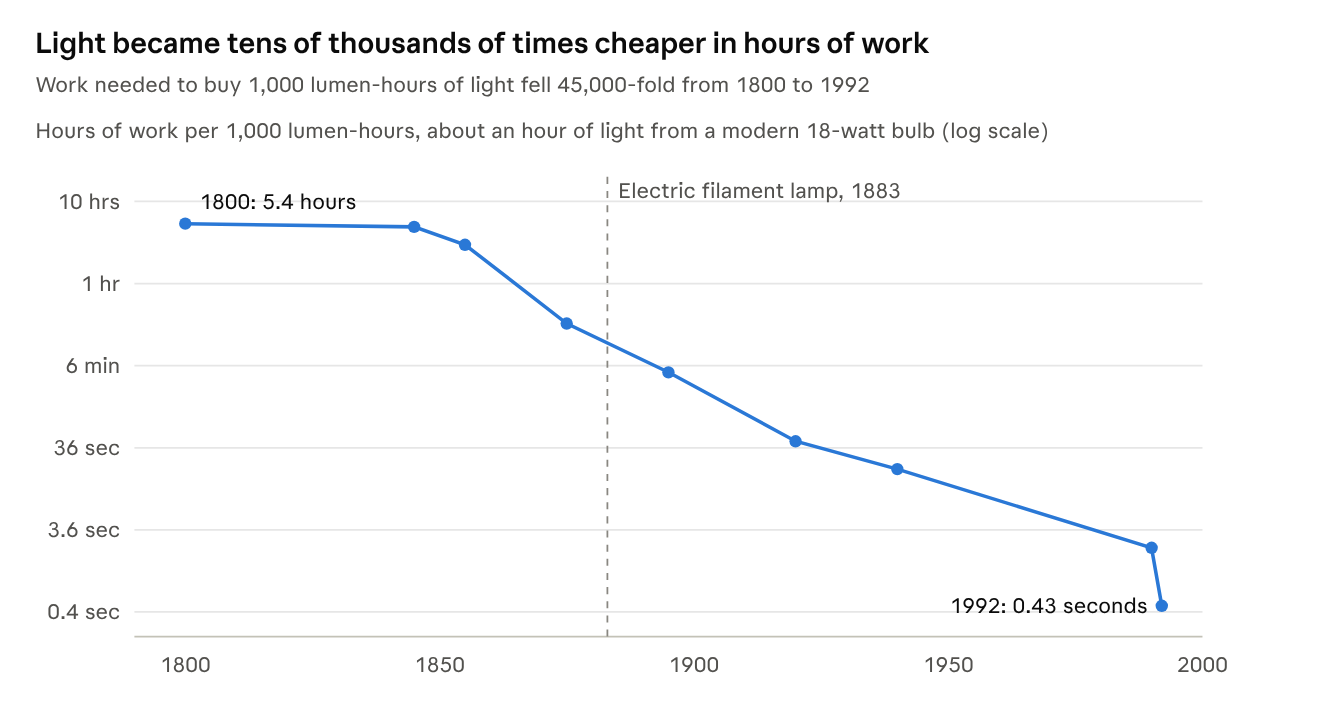
Almost none of that gain showed up as anyone's profit, or even in the official statistics. People simply lived better.
AI is doing to the price of thinking what electricity did to the price of light. The cost of a given level of AI performance is falling by 9 to 900 times a year, depending on the task. If Nordhaus's pattern holds, most of that value will go to the businesses and people who use AI, not to the companies that build it. It will appear as cheaper services rather than higher profits, and it will be bad news for anyone who sells cognitive work at today's prices.
The profits that remain move to the bottleneck
Some businesses do keep far more than 2 percent. Clayton Christensen explained where they come from with his law of conservation of attractive profits. When one stage of an industry becomes good enough and its parts become interchangeable, its profits are competed away. They reappear at the neighboring stage that is still holding the industry back. IBM built the defining personal computer of the 1980s from other companies' parts. The profits went to the two parts no one else could supply: Intel's processors and Microsoft's software.
In AI today, the bottleneck is computing power, and that is where the profits sit. Nvidia earned a 75 percent gross margin on $96.2 billion of revenue in the quarter ending July 2026. The law predicts those profits will move when chips stop being the constraint, perhaps down the chain to power and land, perhaps up the chain to whoever owns the customer and the data.
Christensen shows where profits go. Buffett's test asks whether they will last. Cheap intelligence makes advantages built on expensive knowledge, complex software, or a hard-to-learn interface cheaper to copy. Advantages built on physical scale, licenses, network effects, a scarce input, or trust should last longer.
Price decides the outcome
Investor returns tell the same story. Owning the whole market paid well through every revolution: US stocks returned 6.6 percent a year after inflation from 1900 to 2025, crashes included. Owning the revolution's favorite stocks at the peak did not. The Dow fell 89 percent after 1929 and took 25 years to regain its high. The Nasdaq fell 78 percent after 2000 and took 15. The technology kept spreading the whole time. The investors who lost were the ones who paid too much.
Sorting the US market by industry since 1926 shows which layers of each revolution paid. Figures are annual returns above or below the market, in percentage points:
| Layer | Industry and era | During the frenzy | After the peak | Full cycle |
|---|---|---|---|---|
| Infrastructure | Electric utilities, 1920s | +22.2 | −3.8 | −1.8 |
| Infrastructure | Telecommunications, 1990s | +2.2 | −3.9 | −4.3 |
| Builder | Aircraft, 1920s | +59.8 | −1.4 | +3.1 |
| Builder | Semiconductors, 1990s | +22.0 | −10.1 | +4.4 |
| Builder | Software and internet, 1990s | +21.4 | −5.2 | +4.3 |
| Adopter | Retail, 1920s | −3.6 | +1.8 | +0.4 |
| Adopter | Retail, 1990s | −3.4 | +3.7 | +1.9 |
Source: Kenneth R. French Data Library; calculations for The Last Investment.
The results are similar in both revolutions. The infrastructure layer, which absorbs the most capital, lagged every time. Builders did well over full cycles, but only for those who did not buy at the peak. Adopters gained steadily, and after each crash the parts of the market the frenzy ignored led the way. The chart shows what buying the builders at the top of the last frenzy meant in practice.
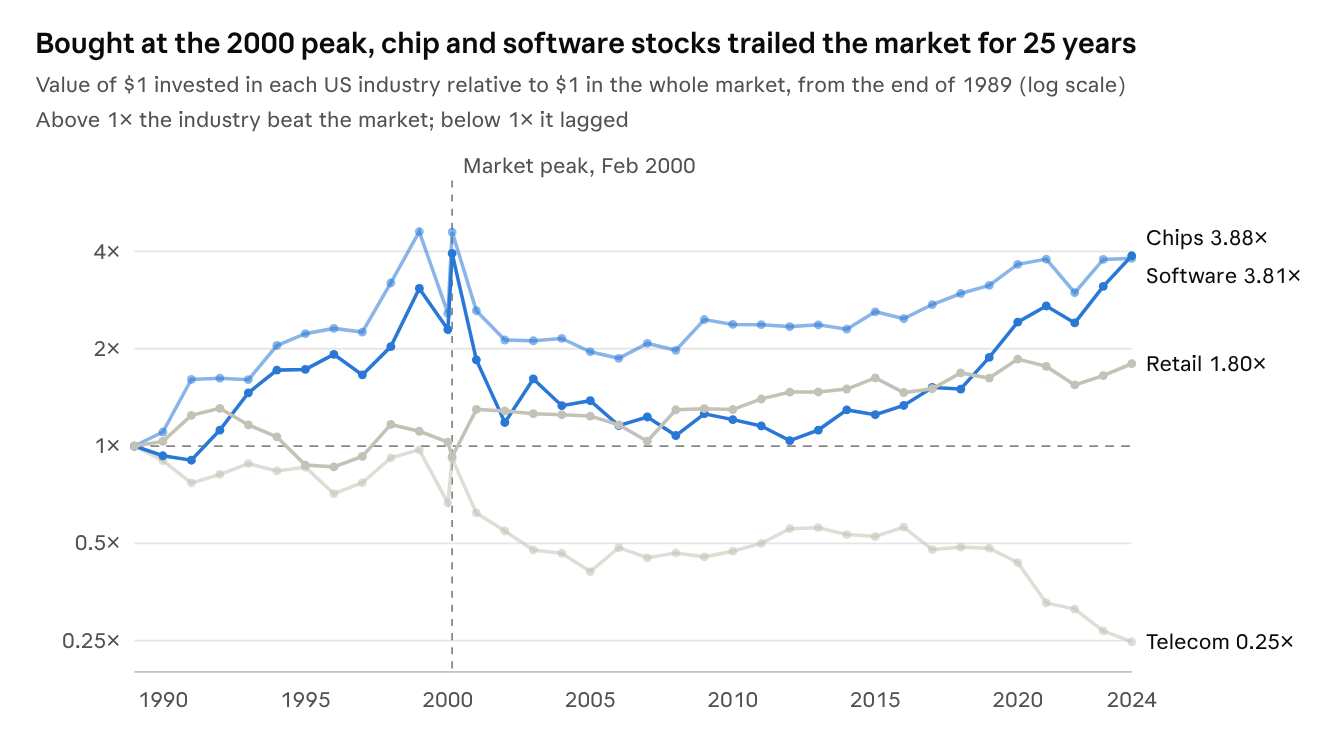
So history gives a consistent answer to who gets paid. Users collect most of the value. The profits that survive move to whatever stays scarce. And the price an investor pays decides whether the investor shares in either. That is the record of every great invention so far. But no earlier invention made all the others. AI may be different in kind. What if it really is the last invention, a machine that makes every invention after it? Part 3 asks which of these patterns would still hold.
Part 3. The Unforeseeable Future
The economy after the last invention
Suppose AI is the last invention. A machine that can make every invention after it can also do most of the work people are paid to do. Labor then stops being the scarce input it has been for two centuries, and the standard economic models give a wide range of answers. Growth could rise once or keep accelerating. Wages could rise or collapse.
Not everyone expects an explosion. Economy-wide productivity is still growing at an ordinary 2.2 percent a year, and if Imas and Garicano are right, each step of AI progress costs more than the last. That case, in which AI keeps improving but the explosion never comes, may be the one today's prices are least prepared for because the spending they assume has to be paid back. It would end for the people funding the buildout much as fiber did in 2001.
Between the optimists and the skeptics lie four broad futures. They are not mutually exclusive.
| Future | Growth | Wages | Real interest rates | Who gains most |
|---|---|---|---|---|
| Explosive growth | Far above historical rates | Uncertain | Sharply higher | Owners of scarce inputs: energy, land, chips |
| Baumol's drag | Moderately higher | Rise for hard-to-automate work | Somewhat higher | Providers of human services; owners of bottleneck assets |
| Capital takes all | Strong | Stagnate or fall | Higher | Owners of AI companies and the resources AI uses |
| Redistribution | Depends on policy | Supported by transfers | Depends on financing | The broad population; capital keeps a smaller after-tax share |
Two things in the table stand out. First, the future most investors hope for is not obviously good for the assets they own. Rapid growth raises real interest rates, and higher rates hurt the long-duration assets that look like the natural way to bet on AI. Second, the gains in the capital-takes-all future would go to very few people. The richest 10 percent of US households own 88 percent of household stocks; the bottom half owns 0.6 percent. A shift that large invites the fourth future, redistribution. No one can know which future will arrive, but each rewards different assets.
What stays scarce when intelligence is cheap
Part 2 showed that profits move to the bottleneck. Applied to a world of cheap intelligence, the question is what intelligence cannot make more of.
Prices already show the pattern. Since 2000, the US price of hospital care has risen 275 percent and college tuition 196 percent, while televisions fell 98 percent. Whatever technology can improve gets cheap; whatever depends on people, land, or permission gets expensive. The economist William Baumol explained the pattern in the 1960s, and AI extends the cheap side into writing, analysis, and code.
The candidates for what stays scarce are physical and human. Electricity and grid connections: at the end of 2025, 2,061 gigawatts of new power projects were waiting to connect to the US grid, and the typical wait exceeded five years. Advanced chips, made largely by one company on one island. Land, sites, minerals, and permits. Goods valued for their rank, such as the best school district. Work valued because a person did it or answers for it. And attention and trust, which matter more when everything else is abundant.
Scarce assets can still be bad investments. A bottleneck everyone can see is usually priced, and high prices call forth new supply, as the fiber glut of 2001 showed. What matters is how long the price assumes the scarcity will last.
Who loses
Some of a revolution's value comes out of other businesses' profits. When intelligence becomes cheap, the businesses most exposed are those that sell it: IT services, call centers, software priced per seat, information publishers, tutoring, agencies, and professional services billed by the hour. The disruption has begun. Chegg, a homework-help company worth $14.5 billion in 2021, lost about 99 percent of its value as students switched to free AI. In February 2026, after Anthropic released new tools for its Claude agent, the S&P 500 software and services index fell nearly 13 percent in five days.
Investors are most at risk here. A business whose franchise is being dismantled looks cheap on every traditional measure, until the earnings disappear. The internet's casualties were textbook cases: US newspaper advertising fell from about $49 billion in 2005 to under $10 billion by 2020, while the stocks looked cheap and paid generous dividends. At a 9 percent required return, a company whose earnings will shrink 5 percent a year forever is worth about seven times earnings. A stock at seven times earnings can be fairly priced, or even expensive.
But markets overreact to fear as they do to hope. The February 2026 selloff swept up businesses with very different exposure, and the opportunity lies in those sold alongside the real losers that own something AI cannot copy. The useful question is whether a stock's decline will be faster or slower than the price already assumes.
Don't bet the farm
No one can forecast which future will arrive, so a portfolio should not depend on a forecast. What history and economics offer instead is a short set of principles that held through every past revolution and do not require predicting this one.
Own the economy, not just the builders. Users capture most of a revolution's value, and the few companies that become enormous are almost impossible to pick in advance: just 4 percent of US stocks since 1926 created all of the market's net wealth. Owning nearly everything is the surest way to own them. Today that takes deliberate effort because the index itself is concentrated in AI's builders. Owning the economy may mean adding AI's users, other countries, and real assets.
Mind the price. The revolutions that rewarded buyers in 1932 and 2002 ruined buyers in 1929 and 2000. In November 2026, US stocks were worth about 221 percent of GDP, the gauge Warren Buffett called "probably the best single measure of where valuations stand at any given moment." At the dot-com peak in March 2000, the figure was about 155 percent. Measured against next year's expected earnings, prices look ordinary, but only if those earnings arrive. Valuation discipline matters most when the story is most compelling.
Follow the bottleneck, but check its price. Look for what intelligence cannot make more of, and ask how long the market already assumes it will stay scarce.
Test durability, and avoid value traps. Favor advantages cheap intelligence cannot copy. For businesses that sell cognitive work, ask what decline the price already assumes.
Hedge the scenarios, not the forecast. Each future rewards different assets, so hold something that does reasonably well in each.
| Future | Assets that tend to hold up | Assets most at risk |
|---|---|---|
| Explosive growth | Owners of scarce inputs; short-term bonds | Long-term bonds and long-duration stocks |
| Baumol's drag, or expensive progress | Hard-to-automate services; real assets in bottlenecks | Sellers of cognitive work; the AI infrastructure buildout |
| Capital takes all | Broad ownership of companies and resources | A household's own earning power |
| Redistribution | Assets hard to tax or already broadly held | Concentrated, visible pools of capital |
Inflation-protected Treasuries, which yielded nearly 3 percent above inflation in August 2026, are a rare fixed point: a real return locked in whatever happens to growth.
Survive the tails, and remember your human capital. Avoid borrowing that can force a sale; many of those ruined in 1929 had bought with 10 percent down. And for most people the largest asset is the ability to earn a living, which is exactly what AI may reprice. Owning a share of the capital that might replace your work is the hedge.
Watch the dashboard. These readings would move first if one future began to dominate.
| Indicator | Latest reading | What a singularity would look like |
|---|---|---|
| US labor productivity growth | 2.2 percent, year to Q2 2026 | Sustained growth well above historical rates |
| Labor share of US business output | 52.8 percent, a record low | A steep, continuing fall |
| 30-year real interest rate | 2.973 percent, highest since 2001 | A sharp, sustained rise |
| Pace of AI research | About 1.9 times its 2024–25 rate at one lab | Accelerating gains driven by AI itself |
| Capability gained per research dollar | Down about 69 percent at the same lab | Rising: each dollar buys more progress |
| Price of AI performance | Falling 9 to 900 times a year | Cognitive work priced near the cost of electricity |
| Share of stocks held by the top 10 percent | 88 percent | Rising further, then pressure to redistribute |
In late 2026 the readings show real change, but nothing decisive yet. The inputs to AI are improving at extraordinary rates, and the labor share and real rates are moving the way the dramatic futures predict. But productivity has not broken from its historical range, and AI progress is getting more expensive. A portfolio should change when these readings change, not when the headlines do.
That leads to this paper's answer. If the last invention does arrive, it is unlikely to be the last investment. A machine that can make every invention that follows makes invention itself cheap, and history says the value of cheap things flows to the people who use them and to the owners of whatever stays scarce. The returns from the last invention will go to what it cannot make: energy, land, chips, trust, and a broad share of the economy it transforms. No single bet is likely to capture them.
Conclusion: The Last Investment
This paper began with a question. If we are building the last invention, will it also be our last investment? Will one bet, on the right lab or the right chip, settle everything that follows?
History suggests not. The railway, electricity, the automobile, and the internet each remade the world, and none of them handed it to the people who built it. Three lessons held in every one of them. Most of the value of a transformative technology goes to the people who use it. The profits that innovators keep move to whatever remains scarce. And the price an investor pays decides most of the outcome. Even the builders that survived rewarded only those who did not overpay, and the layer that laid the infrastructure, from railways to fiber, earned the least of all.
As of November 2026, the readings point two ways at once. The signs of something new are real: AI measurably helping to improve AI at one lab, agents completing tasks that once took most of a working day, the price of machine intelligence falling by orders of magnitude a year, and labor's share of income at a record low. The signs of a familiar pattern are just as clear: ordinary productivity growth, profits concentrated in the companies selling picks and shovels, a stock market worth more, relative to the economy, than at its 2000 peak, a second reading that finds AI progress getting more expensive rather than self-sustaining, and hundreds of billions a year spent on infrastructure in the expectation that demand will grow into it. Both can be true. Perez's history says that a frenzy can install a real revolution and still ruin the people who pay for it.
Good's sentence carried a proviso: the machine would be the last invention "provided that the machine is docile enough to tell us how to keep it under control." That is the one risk no portfolio can hedge. Every principle here assumes that property rights hold, markets function, and the future still belongs to people. The most important investment of the coming decades may not appear in any brokerage account: the effort to make sure the most powerful technology ever built remains something people can understand, direct, and trust.
There is also good news here. If innovators keep only a sliver of what they create, most of the value of every revolution has gone to everyone else. If the singularity arrives and that pattern holds, its largest beneficiaries will be the people who use what it makes possible. No investor can know in advance who will own the last invention. But an investor can own a broad share of the economy on the other side, pay sensible prices for it, avoid the bets that end the game, and keep watching the readings as they change.
Get the 47-second read.
AI news for investors, free every weekday morning. Plus this 19-page whitepaper as a PDF.
Sources
Acemoglu, "The Simple Macroeconomics of AI" (NBER)
Berkeley Lab, interconnection queue backlog (LBNL)
Bessembinder, "Do Stocks Outperform Treasury Bills?" (Arizona State University)
Buffett, "Mr. Buffett on the Stock Market" (Fortune, 1999)
Buffett indicator, US market value to GDP, November 2026 (USMacro); Buffett on the measure (Nasdaq)
Bureau of Labor Statistics, labor share and productivity, Q2 2026 (labor share; productivity)
Chegg (European Business Magazine); Teleperformance (CX Today); February 2026 software selloff (BNN Bloomberg)
Chow, Halperin, and Mazlish, transformative AI and real interest rates (Open Philanthropy)
Christiano, slow takeoff definition (AI Impacts)
DeepSeek and Nvidia, January 2025 (Tom's Hardware)
Epoch AI, training compute and inference prices (compute; prices)
FactSet Earnings Insight, November 13, 2026 (FactSet)
FDIC, fiber utilization in 2002 (FDIC)
Federal Reserve Distributional Financial Accounts (PennyCalc; FRED)
French, Data Library, 49 industry portfolios (Kenneth R. French)
Gartner hype cycle (Gartner)
IEA data center electricity outlook (Data Center Dynamics)
Imas and Garicano, "Are we approaching an intelligence explosion?" (Substack)
Jordà et al., "The Rate of Return on Everything" (NBER Reporter)
METR, AI R&D acceleration assessment and time horizons (assessment; time horizons)
Nordhaus, Schumpeterian profits (NBER Digest); the price of light (Our World in Data)
Nvidia fiscal Q2 2027 results (StorageNewsletter)
Odlyzko, "The Railway Mania" (University of Minnesota)
Perez, "What Is AI's Place in History?" (Wladawsky-Berger)
Pew Research Center, newspaper revenue (Pew)
TIPS auction, August 2026 (PrimeRates)
TSMC foundry share (Notebookcheck)
UBS Global Investment Returns Yearbook 2026 (WealthBriefing)
US price changes, 2000–2025 (Henssler Financial)
METR's assessment concerns Anthropic, the company whose model, Claude, helped prepare this paper.